____________________________________________________________________________
1. Which of the following is NOT a monosaccharide? sucrose
____________________________________________________________________________
2. Which functional groups are present in all monosaccharides? hydroxyl and carbonyl
____________________________________________________________________________
3. Which of the following sugars are classified to have an aldehyde
group? glucose and galactose
____________________________________________________________________________
4. Which of the following sugars are ketoses? fructose
____________________________________________________________________________
5. Which carbon in a sugar is the anomeric carbon? the carbonyl carbon
____________________________________________________________________________
6. In the Haworth projection of a sugar, if the hydroxyl group on the
anomeric carbon is pointing down, the sugar is in the alpha
____________________________________________________________________________
7. Which carbon determines a carbohydrates' D or L configuration? the chiral carbon farthest from the carbonyl carbon
____________________________________________________________________________
8. Which best describes carbohydrates that are anomers? differ at the anomeric carbon
____________________________________________________________________________
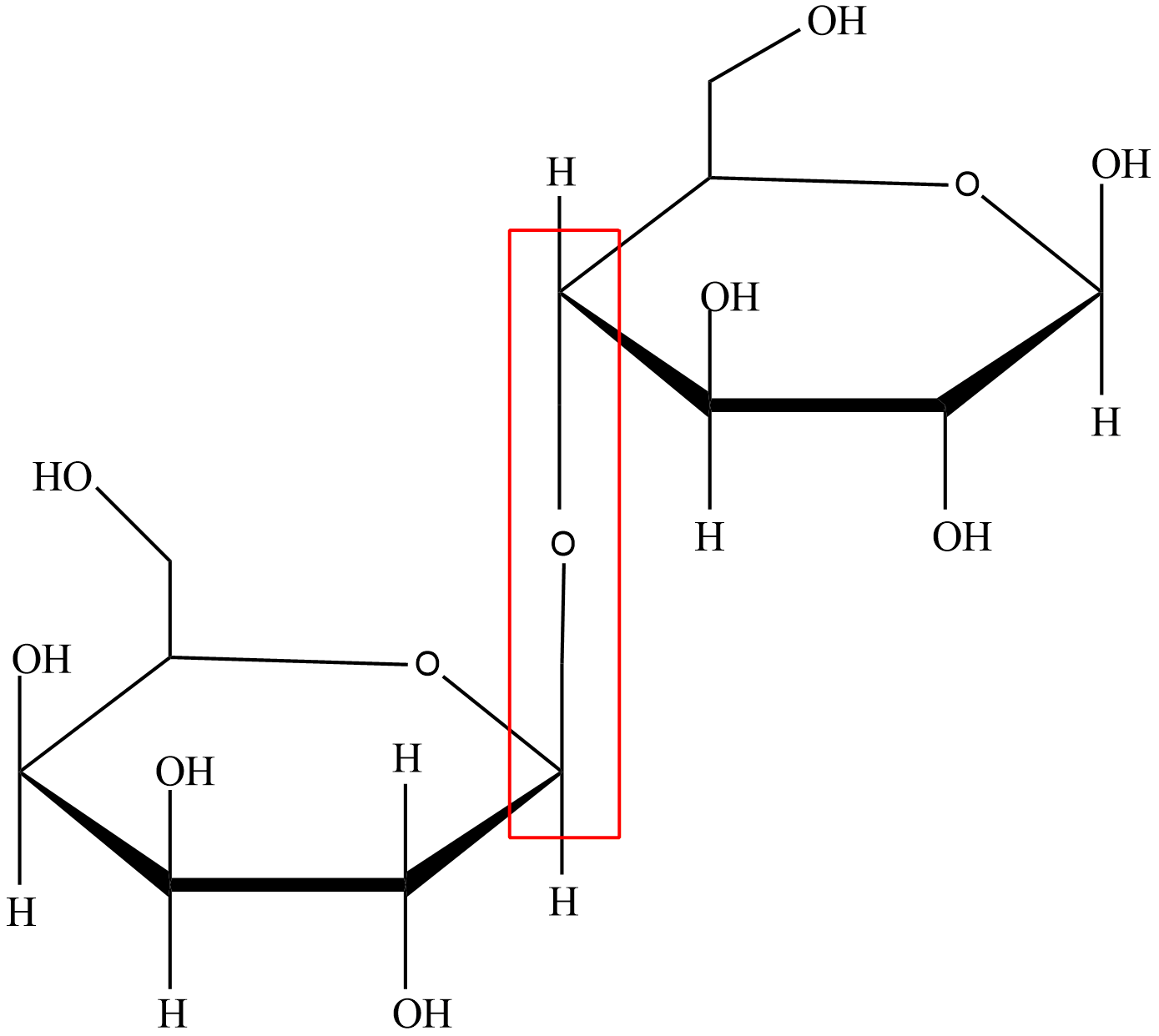
9.
The molecule shown in the image is a disaccharide
____________________________________________________________________________
10. The diagram depicts what kind of a glycosidic bond? beta-1,4-glycosidic bond
____________________________________________________________________________
11. On a haworth projection, which way does the C5 (CH₂OH) carbon point in a
D sugar? up
____________________________________________________________________________
12. Which of the following is NOT a common disaccharide? ribose
____________________________________________________________________________
13. Which of the following polysaccharides is used for energy storage in
plants? starch
____________________________________________________________________________
14. Which of the following polysaccharides is used for energy storage in
animals? glycogen
____________________________________________________________________________
15. Which of the following polysaccharides is a structural component in
plant cell walls? cellulose
____________________________________________________________________________
16. Which of the following polysaccharides is a structural component in
fungal cell walls and arthropod exoskeletons? chitin
____________________________________________________________________________
17. Humans lack the enzyme to digest which of the following
polysaccharides? cellulose
____________________________________________________________________________
18. Epimers differ at one chiral carbon
____________________________________________________________________________
19. Which of the following are epimers of glucose? galactose and mannose
____________________________________________________________________________
20. Disaccharides are formed when two monosaccharides are joined by which
type of reaction? dehydration
____________________________________________________________________________
21. Which of the following is true regarding hydrolysis of different
glycosidic bonds? different linkages require different enzymes for hydrolysis
____________________________________________________________________________
22. Which of the following is true regarding keto-enol tautomerization of
sugars? It is the reason sugars can convert from one sugar to another
____________________________________________________________________________
23. Hemiacetal rings form when a nucleophile attacks which functional group
in a sugar? the carbonyl carbon
____________________________________________________________________________
24. What is the primary difference between starch and cellulose that makes
starch digestible by humans and cellulose indigestible? the type of glycosidic bond
____________________________________________________________________________
25. Why is glycogen considered a more efficient energy storage molecule than
starch? it is more highly branched
____________________________________________________________________________
26. Which two enzymes cleave polysaccharides into monosaccharides in the
human digestive system? amylase and maltase
____________________________________________________________________________
27. Which best describes benedict's reagent? a test for reducing sugars
____________________________________________________________________________
28. Which of the following sugars cannot be reduced by Benedict's
reagent? sucrose